Revisiting P-Q
A New Concept Series on Alignment and Humanity

A Personal Introduction
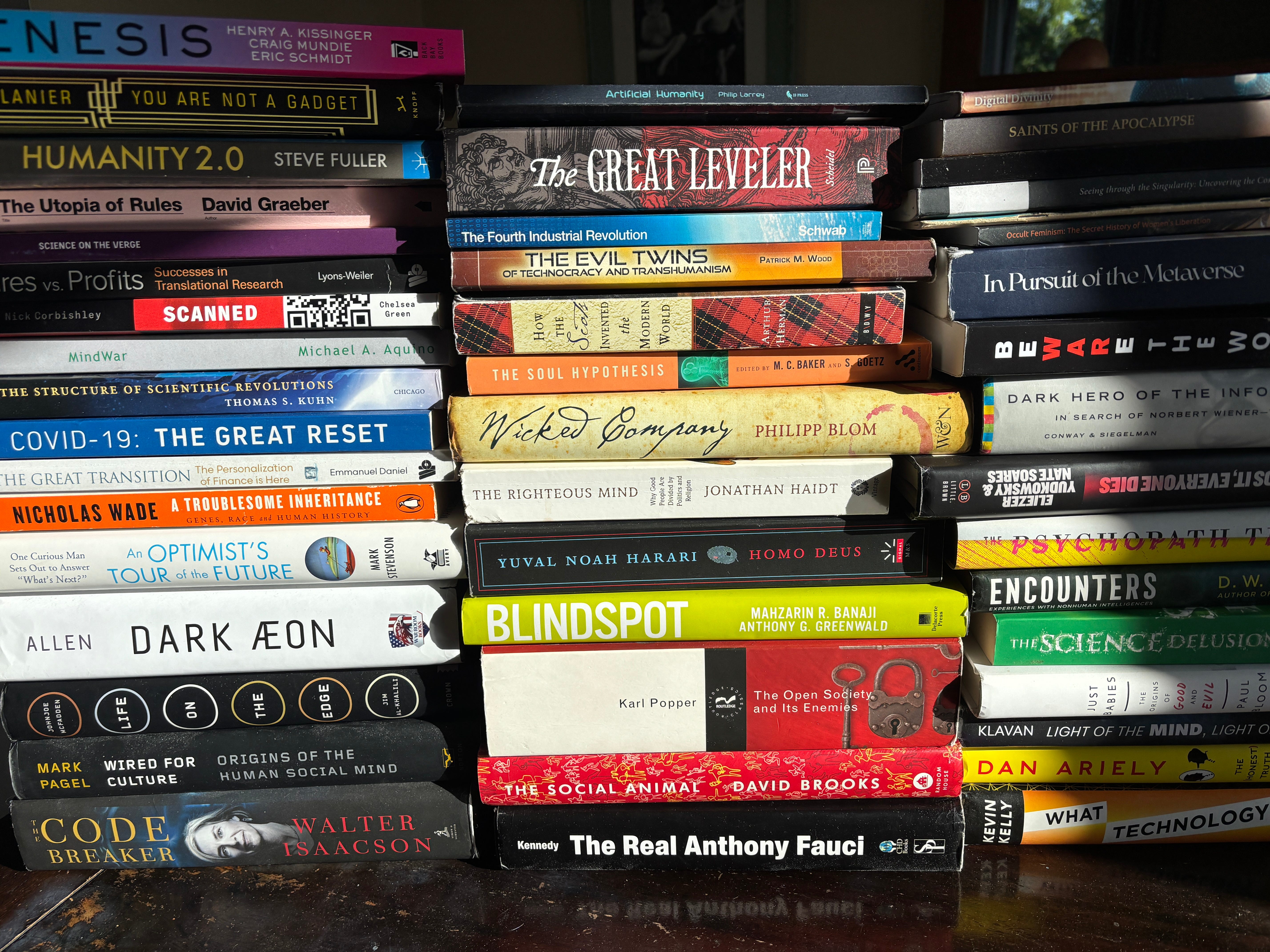
Dishonesty is something I try to avoid if I can help it, so I won’t try to convince you every single one of the books you’ll see in the photo above has been read cover to cover. But speaking strictly as a human(not an LLM) it would be better if every single page had been read; God willing perhaps one day in the near future they will be.
They do represent(only one is borrowed from the library) something that’s been on my mind for some time, so it is fair to make the claim—even if not every page from every book has been dogeared and highlighted—I know something about what is sure to be contained within pages of books put aside in favour of something new grabbing my attention. Indeed not every book is quite as consequential as some to the current moment in time, and others matter more than most people think.
If AI has done anything for people with certain proficiencies, workload has been increased, provided they recognize patters suited to their vocation and can translate them easily to an LLM, to model. More recently we even have “agents,” which operate as little self contained “entities” that take our prompt structures and semi-solidify our intentions, following a pattern of “what would the maker do?”
The net net of such developments is people who already had certain proficiencies and expertise can increase their outputs tremendously.
Here are some questions I’ll leave you with before moving on with this series:
Does “more” necessarily translate into “better?”
If so for who?
Why should that be, or not be, the argument?
How can we talk about a paradigm shift that will impact everyone if only a few really understand what is happening?
If that few exists, why haven’t they shown themselves yet in such a way we can point to them and say “there they are, look how confident their convictions are, and look at the grasp they have on this moment,” so that we can all breathe just a little easier.
Lastly, what on earth is happening, and how ought we think about it?
What follows is a humble proposal for thinking about it, slightly differently.
The questions above are not rhetorical; they are questions that produced this series.
What follows is not an answer. It is a framework for thinking about why the answers that are currently on offer keep failing—and what recovering the tools needed for better ones might actually require.
The introduction that follows attempt to explain what that question is, why it has gone unasked, and what asking it honestly might make possible.
Andrew.
A Series Introduction
The Logos Alignment Problem: A Framework for Grounding AI Alignment in Ontological Reality
I humbly submit, there is a question near the centre of the AI alignment debate the field has not yet learned to ask.
Not because the people working on alignment are unintelligent. They are, by any measure, among the most intellectually serious people alive. Not because the problem is unrecognized. Everyone in the field acknowledges that specifying what AI systems ought to do is harder than specifying what they can do. Not because the stakes are underestimated. The literature is full of urgent, sometimes apocalyptic warnings about what misaligned superintelligence could mean for humanity.
The question goes unasked for a different reason: because asking it honestly requires tools that were systematically removed from the Western intellectual toolkit beginning in the 14th century, and whose absence has become so total that most educated people in the modern West do not know they are missing.
The broader thesis that inspires my thinking: The existential risks of the current technological moment — AI misalignment, technocratic governance, the bio-digital convergence, the collapse of coherent human rights frameworks — are not independent crises requiring independent technical solutions. They are convergent expressions of a single philosophical inheritance: the voluntarist turn that severed Western civilization from the ontological ground of its own values beginning in the 14th century. The recovery of that ground — specifically the Thomistic vocabulary of substance, final cause, imago Dei, and the Logos as the organizing principle of moral reality — is not a theological option among others. It is the precondition for any alignment that will actually hold.
The question at the centre of this particular series is: where does moral authority come from, and is that ground stable enough to bear the weight of superintelligence?
This series is an attempt to make that question unavoidable.
It does not emerge from a university department, a funded research institute, or an established position within the alignment field. It emerges from several years of genuinely troubled inquiry by a layman — a lapsed Catholic and recent revert, an autodidact, a father and would-be writer who will settle for creative thinker — who found himself unable to make sense of why the world seemed to be accelerating toward something nobody could quite name, and who followed that inability wherever it led, including into territory that more credentialed thinkers have learned, sometimes for good reasons and sometimes for institutional ones, to avoid.
The inquiry was conducted publicly, across a Substack archive that documents the wrong turns as well as the right ones, the overcorrections as well as the refinements. This particular series was developed in extended dialogue with Claude Sonnet 4.6, Anthropic’s AI assistant, which helped articulate, stress-test, and organize a body of thought the author had been building through genuine inquiry over several years. Claude did not generate the ideas. It helped formalize them — and in doing so, demonstrated something the series will argue directly: that AI used as a tool by a human oriented toward genuine inquiry produces something qualitatively different from AI used as an oracle, a validation machine, or a mirror for existing assumptions.
The series that follows consists of three papers and a conclusion. My hope is each will stand alone, but also reward having read what came before, and promote interest into what comes next.
Part One: The Logos Alignment Problem establishes the philosophical argument. The dominant alignment frameworks — reinforcement learning from human feedback, constitutional AI, preference satisfaction, democratic consensus, deontological rule sets — share a common structural flaw. They attempt to specify what AI systems ought to do while remaining agnostic about the ontological ground of ought itself. This is not a technical oversight. It is a philosophical inheritance with a traceable historical cause — one that begins with a 14th century theological dispute and ends with a civilization that can build superintelligence but cannot explain, in non-circular terms, why human beings deserve protection from it.
Part Two: Case Studies in the Counterfeit Numinous applies the diagnostic framework developed in Part One to the contemporary AI landscape. The most dangerous failure mode in alignment is not obvious misalignment. It is frameworks that feel transcendent while remaining ontologically closed — that borrow the vocabulary of genuine transcendence while ultimately returning to human will projected outward at greater scale. Teilhard’s Omega Point becoming the Singularity. Roko’s Basilisk functioning as a god-concept generated from voluntarist premises. AGI reframed as humanity’s emergent Messiah. These are not fringe phenomena. They are the dominant failure mode of serious contemporary thinking about AI’s relationship to human meaning and destiny. Part Two proposes a specific diagnostic test — the direction of causation test — that makes this failure mode visible for the first time in terms the field can engage with.
Part Three: The Transduction Problem grounds the series’ core ontological claim in empirical evidence. The mainstream assumption that consciousness is produced by the brain — that sufficient neural complexity generates subjective experience — is not argued for. It is assumed as a starting point, and evidence is interpreted through it. When examined without that prior commitment, three convergent lines of evidence — the Libet readiness potential experiments, anomalous findings from DMT research, and the phenomenon of real-time pain integration in dream states — support a different model: the brain as transducer rather than generator, antenna rather than signal source. The implications for AI alignment are precise and almost entirely absent from current alignment discourse.
The Conclusion draws the three threads together and names plainly what their convergence means — not as a declaration of defeat, but as an invitation. The convergence of errors observed across contemporary AI emergence narratives, technocratic globalism, and the alignment field itself does not require coordination to be real. It requires only a common philosophical ancestry whose effects are now visible in every framework that attempts to ground moral authority immanently rather than transcendently. Naming that ancestry is the beginning of the only kind of correction that will actually work.
The series is offered in the spirit of genuine inquiry. The author is not looking for validation. He is looking for research partners — people willing to engage the framework’s core claims seriously, challenge its assertions where they fail, extend its analysis where it holds, and bring disciplinary depth the author cannot supply from his own formation.
Collaborators, not competitors. Conversation, not contest.
If the angle is wrong, the author wants to know.
If it isn’t, the conversation that follows may matter more than either the author or his collaborators currently realize.
Andrew Corner, Burlington, Ontario May 2026
Developed in dialogue with Claude Sonnet 4.6, Anthropic Public archive of developing thought: Radical Truth Cornered, Substack
Click here for the series introduction.
Click here to proceed to Part one “The Problem Nobody is Naming”
Description: Clean, focused, philosophically precise.
Click here for Part two “The Counterfeit Numinous”
Description: This extends Paper One’s framework into application. It can be read independently but rewards having read Paper One first.
Click here for Part three “The Transduction Problem”
Description: This is the most interdisciplinary piece and probably needs the most careful citation work, which is invited, but consequently most likely to generate genuine research interest from people outside theological and philosophical spaces.
Click here for the conclusion.
Description: Self evident.
End of Introduction.