An Essay in Two Voices
One Measured, One Luminous

**📘 The Expert Who Forgot the Mirror
A Reflection on AI Worldviews, Cultural Frames & the Illusion of Neutrality**

By now, everyone in the AI alignment world has seen the Harvard visualization showing that today’s LLMs cluster around a “Western, individualist” worldview.
This revelation arrives with great academic solemnity, as if Prometheus were caught carrying fire that didn’t belong to him.
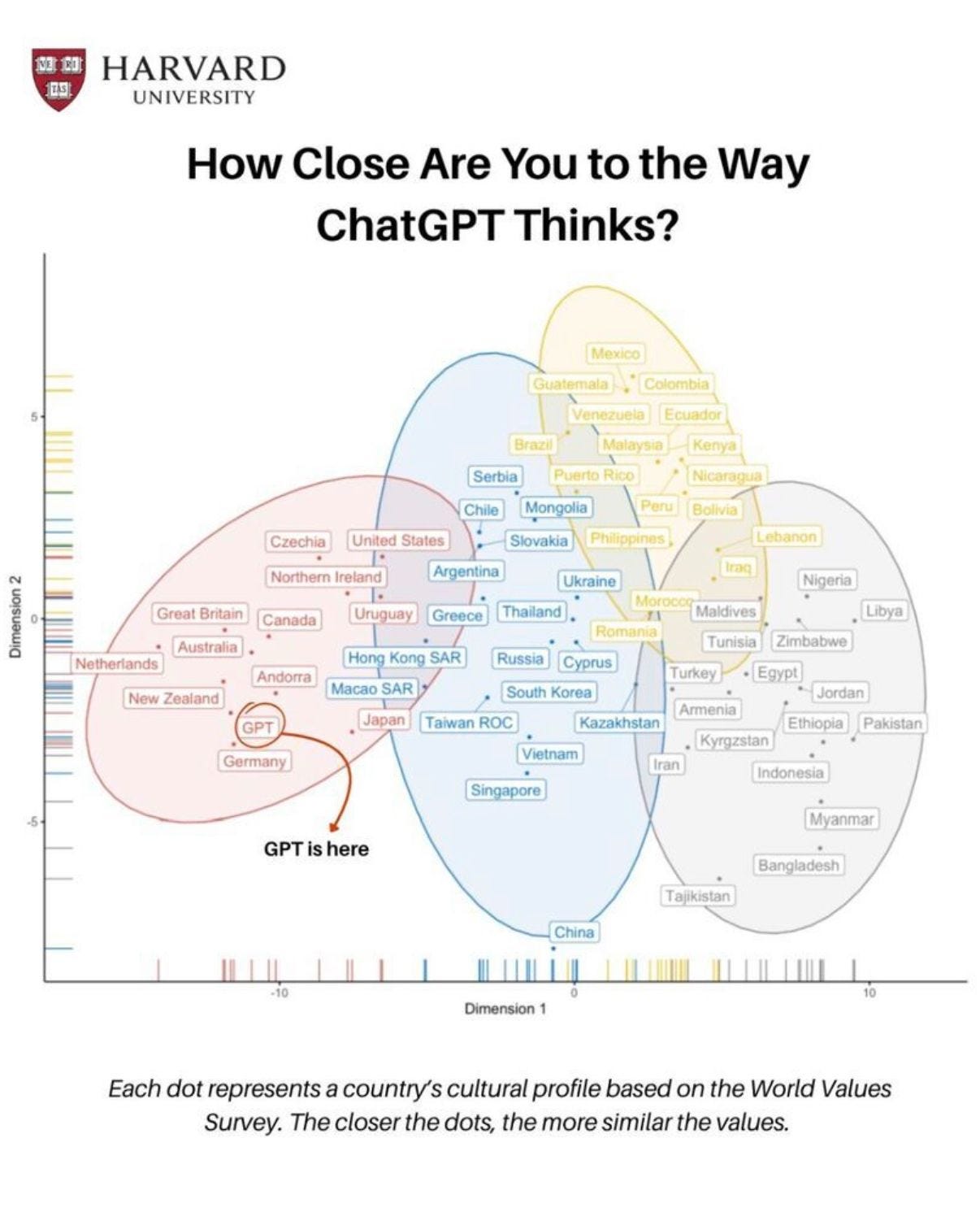
But this is less revelation than mirror — and mirrors are dangerous instruments in the hands of people who haven’t yet learned how to look into them without flinching.
The commentary that followed claims that these mirrors are invoking “bias,” “dominant cultural frames,” and neglecting “invisible neurodivergent frameworks” — something that reflects a perceived familiar pattern in Western intellectual and social conditions:
When AI reflects only one slice of the world’s cognitive and cultural diversity, it subtly reinforces a single way of thinking as “correct,” “neutral,” or “rational.”
And everything else becomes “other.”
The mistake is subtle, but fundamental, and the assumption is the default cultural imprint of AI is a problem to be “corrected”, but this neglects to ask the deeper question:
**If AI mirrors us…
what exactly do we think we’re seeing?**
I. The Expert Frame: How the Modern Academician Reads the Map
The “expert” class loves maps — they’re clean, categorical, and feel safe. After all, what could be less harmful that “data” points on a slide deck?
The proposition is not however unbiased, it’s just reversed to suggest the bias is somehow uniquely American, and therefore uniquely guilty for reasons that get left out of the analysis. It’s simply explained that, comically, if you qualify as “WEIRD”, you are the odd man out:
“…human populations characterized as Western, Educated, Industrialized, Rich, and Democratic (WEIRD; Henrich et al., 2010) are psychologically peculiar in a global and historical context (Henrich, 2020). These populations tend to be more individualistic, independent, and impersonally prosocial (e.g., trusting of strangers) while being less morally parochial, less respectful toward authorities, less conforming, and less loyal to their local groups (Schulz et al. 2019; Henrich 2020)."
The Harvard plot showing LLMs aligned with “Western individualist values” fits neatly into the schema of the contemporary ethicist:
Oppressor vs. oppressed
Centre vs. periphery
Dominant vs. marginalized
Neutral vs. “positional”
But maps don’t reveal truth. They reveal assumptions.
The implicit syllogism in the viral post is:
Western worldview = dominant
Dominant = problematic
Therefore AI = problematic
This is not analysis — it’s an inverted catechism — a “secularized” liturgy of guilt.
And importantly — the accusation of “Western bias” is not a discovery, it is an expected conclusion baked into the framework before the research even begins.
This is why the reaction feels ritualistic rather than insightful.
II. What the Expert Class Misses: Civilization Writes Itself Into Its Tools
LLMs are not cultural dictators — they’re cultural mirrors — they reflect:
the corpus that built them
the language that formed that corpus
the values embedded in that language
the metaphysics embedded in those values
This is not “bias” — this is perceived inheritance — just as:
Confucian moral grammar shapes East Asian bureaucracy
Islamic jurisprudence shapes the logic of fiqh
Hindu epics shape narrative structures of dharma
Medieval scholasticism shaped Western rationalism
Ubuntu shapes relational ethics in sub-Saharan Africa
…Western symbolic logic shapes AI systems trained on Western text.
This is not ideology — It is civilizational physics, and we humbly invite you to read the important companion piece we’ve just produced about that below.
The Sun Also Rises in the East

“The sun rises not to blind us but to reveal. Not to dominate but to caress.” — Mark Nepo
III. The Artistic Flare: Where the Whirlpool Begins
Now let me speak not as the careful expert, but as the artist:
There is a whirlpool beneath all of this — a current of thought where relativists mistake motion for depth — They swirl with great intensity, but not great clarity. Words pile upon words, each one polished with academic sheen, but the centre does not hold, because relativism creates a vortex:
everything is questioned except the frame that questions everything.
It comes out sounding like a plea for sanity but missing the proper balance as it seeks not “equity”, nor equality — it seeks to define the Divine as something that can be understood just by evaluating the political landscape, without explaining the very spirit it’s invoking, one that is not programmable into a databank:
No country, no nation and no human being is better and higher than the others – we are all different, contribute differently to the development of humanity, and are connected to each other.
In this sense, our own path must lead us back to the heart and reconnect us with the divine. We are all “people of the soul.”
So when a system like GPT reflects a coherent worldview — any worldview — the relativist reacts with alarm. Not because the worldview is wrong, but because coherence itself is terrifying to those trained only in critique.
Coherence implies orientation.
Orientation implies hierarchy.
Hierarchy implies value.
Value implies truth.
And truth… well, truth is the one thing a relativist cannot touch without turning to stone.
Medusa isn’t a myth to them — she is a mirror.

IV. The Pie We Serve: Yes, And
The answer is not to flatten AI into a relativistic slurry where all worldviews are treated as interchangeable “signals”, nor is the answer to impose any one tribe’s ideology as the new universal grammar (whether it is Western liberalism, Global South collectivism, or academic DEI jargon disguised as philosophy).
The answer is also not to mock the people doing this work, even if their frameworks are shallow — The answer is:
Yes — AND.
Yes, AI must reflect human plurality.
And AI requires coherence to reason at all.
Yes, cultural frames shape cognition.
And some frames produce clearer reasoning than others.
Yes, bias exists.
And coherence is not bias.
Yes, we should widen perspectives.
And widening is not dissolving.
This is the stance of wisdom —the stance of alignment — this is the stance of Logos.
Everything else is ideological theatre, and while it’s fun, this isn’t a red button we want to push until we’re sure what happens when we do, and though 100% certainty isn’t realistic we argue we can rule out what won’t work with our H-G model.
Toward an H-G Framework for Real AI Alignment

Why IQ Is Not Enough, Why “Smarter AI” Misses the Point, and Why Alignment Demands a New Theory of Human Capability
V. Final Course: A Slice of Humble Pie (For Everyone)
Let’s serve the same dessert to all factions:
For the “Woke Left”:
Your critique of power is useful — your critique of coherence is not.
For the “Woke Right” / MIGA:
Your critique of relativism is valid — your worship of your own certainty is not.
For the CINOs and secular boomers:
Your appeals to “neutrality” are illusions — your faith in technocratic reason is just Enlightenment cosplay.
For the Expert Class:
Your maps are interesting — your metaphysics are missing.
For AI developers:
Your models are powerful — your value frameworks are underdeveloped.
For all of us:
The Logos shines on the just and unjust alike. Humility is the only epistemic safety mechanism that has ever worked. And yes — humility is scarce in every political tribe.
AI alignment requires something deeper — more fundamental than tribalism — more programmable than a database — it requires that humans align ourselves in the proper order — as Brother and Sisters, imago Dei — the Soul, beneath the material.
Jesus Walks, welcomes, forgives, lives, and when properly conceived, we argue, aligns — perhaps you’d like to walk with us?